Bien que la période estivale soit normalement plus calme sur les marchés, le mois de juillet a été dominé par la publication des résultats de plusieurs entreprises du groupe des Sept Magnifiques. Comme prévu, l’intelligence artificielle (IA) est demeurée un thème central. À cet égard, les prévisions en matière de dépenses en capital (capex) et les commentaires des dirigeants ont grandement influencé la réaction des marchés. Amazon, Alphabet, Microsoft et Meta ont continué d’investir massivement dans les infrastructures nécessaires pour répondre à la demande liée à l’IA.
Si les investisseurs ont dans un premier temps salué la hausse des investissements dans l’IA comme un gage de croissance future, l’attention s’est progressivement tournée sur une autre problématique, potentiellement plus cruciale : quand ces investissements commenceront-ils à générer des rendements significatifs?
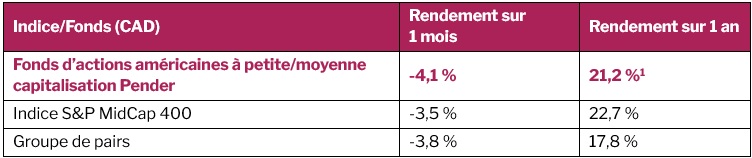
Source : Morningstar , au 31 juillet 2026
Dans le lot des entreprises qui ont publié leurs résultats, Amazons’est taillée une place bien à elle. En effet, les investisseurs ont réagi favorablement à l’accélération de la croissance d’Amazon Web Services (AWS) et à la forte demande en matière d’IA. Le chiffre d’affaires d’AWS a progressé de 37 % sur un an — soit son rythme le plus rapide en 18 trimestres. La société a produit plus de 60 % du résultat opérationnel consolidé d’Amazon pour le trimestre, renforçant ainsi son rôle de moteur de rentabilité pour l’entreprise. Bien que la direction ait augmenté ses prévisions de dépenses en capital pour 2026 à environ 220 milliards USD, elle a indiqué que la demande continuait de surpasser ses capacités actuelles. En fait, une grande partie des capacités ajoutées au niveau de l’infrastructure en vue de 2027 est déjà réservée, le tout alors qu’Amazon révèle que la demande pour 2028 s’annonce substantielle.
La direction a souligné que les serveurs dédiés à l’IA, dont la durée de vie est d’au moins 5 à 6 ans, devraient atteindre le seuil de rentabilité en moins de trois ans. Parallèlement, les centres de données sous-jacents ont une durée de vie utile supérieure à 30 ans et peuvent accueillir plusieurs générations de serveurs. Il est également prévu que les générations ultérieures offriront une rentabilité encore plus élevée. Andy Jassy, président-directeur général de la société, a fait remarquer que les marges et les rendements liés à l’IA suivent une trajectoire comparable, voire légèrement supérieure, à celle des premières années d’AWS.
Lors de sa première conférence sur les résultats en tant que société cotée en bourse, Space Exploration Technology Corp (SpaceX) a indiqué qu’elle prévoyait une capacité de calcul de 2 GW à la fin de 2026 (contre 1,4 GW précédemment). Ce faisant, la société pourrait dégager un chiffre d’affaires annualisé de 100 milliards $ pour ses services dans les nuages d’ici la fin de 2026. La capacité de calcul devrait encore augmenter pour atteindre jusqu’à 10 GW d’ici la fin de 2027. Au T2, SpaceX a investi 15,8 milliards $ dans des infrastructures de calcul pour l’IA, sur un total de 18,4 milliards $ en capex. Elle s’attend à ce que le déficit sur le plan de l’offre dans le marché du calcul persiste. Les conditions économiques actuelles se traduisent par un délai de récupération inférieur à un an pour les nouveaux investissements, et la rentabilité s’améliore avec chaque nouvel accord conclu.
Nous estimons que la hausse des investissements dans les infrastructures d’IA crée des occasions pour les petites et moyennes entreprises (PME), notamment pour plusieurs sociétés qui se trouvent dans notre portefeuille. Nous continuons de privilégier les compagnies de grande qualité dotées d’équipes de direction solides, de positions concurrentielles durables et de perspectives de réinvestissement à long terme. Même si les marchés risquent de demeurer volatils pendant que les investisseurs s’interrogent sur le rythme et la rentabilité des dépenses liées à l’IA, nous pensons que de telles périodes occasionnent des opportunités attrayantes aux investisseurs patients et tournés vers le long terme, prêts à voir au-delà du prochain trimestre.
Mise à jour supplémentaire
La saison des bénéfices a continué de retenir toute notre attention et, dans l’ensemble, les renseignements recueillis nous ont redonné courage. Les thèmes récurrents au sein de nos avoirs sont les suivants : résilience de la demande, amélioration de l’exécution opérationnelle et placements dans des occasions de croissance à long terme. Voici quelques faits saillants :
Generac (GNRC): Le trimestre s’est avéré particulièrement solide avec maintien des prévisions pour 2026. Le carnet de commandes lié aux centres de données a atteint 1,6 milliard $ (contre 700 millions $ à la fin du T1), grâce à une commande de 700 millions $ passée par un fournisseur de services à très grande échelle, leur premier. La société est par ailleurs en pourparlers avec un deuxième tel fournisseur pour une commande similaire ou plus importante encore.
Fluor (FLR): Les résultats du T2 ont été supérieurs aux attentes et les nouvelles commandes s’élèvent à 6,1 milliards $, ce qui en fait son trimestre le plus dynamique depuis le T1 2024. La demande en matière de production d’électricité continue de croître, portée par l’essor des centres de données, l’expansion industrielle et l’électrification de manière générale. Nous estimons que cette dynamique crée des avenues tant pour les centrales de gaz naturel que pour le nucléaire, ce qui pourrait soutenir la croissance du carnet de commandes au premier semestre (S1) de 2027.
StandardAero (SARO): On a assisté à un autre trimestre solide dans les secteurs de l’aéronautique commerciale et de l’aviation d’affaires. La direction a relevé ses prévisions pour 2026 et a réaffirmé ne pas prévoir de répercussions liées à la hausse du prix du kérosène. L’entreprise opère sur les plateformes de moteurs les plus économes en carburant et près de 40 % de son activité repose sur des marchés finaux insensibles aux fluctuations du prix du carburant.
Modine (MOD): Modine a réalisé un nouveau trimestre solide, porté par une croissance de 90 % du chiffre d’affaires lié aux centres de données et par un troisième trimestre consécutif de prises de commandes record. En effet, son carnet de commandes a presque doublé en un an. Si les marges à court terme ont subi des pressions dues aux contraintes d’approvisionnement, la direction a maintenu ses prévisions pour l’exercice 2027 et s’attend à une amélioration des résultats à mesure que de nouvelles capacités entreront en service.
Microchip (MCHP): La société a affiché des résultats trimestriels solides, supérieurs aux prévisions. Les ventes dans le marché des centres de données ont bondi de près de 100 % au cours du trimestre clos en juin. La direction prévoit par ailleurs une croissance de 69 % de ces ventes pour l’année civile 2026, pour atteindre environ 1 milliard $.
Evercore (EVR): Evercore a enregistré une croissance de son chiffre d’affaires de 19 % sur un an, bien que les résultats aient été plus modérés par rapport à son T1 record. Avec un carnet de commandes qui frôle ses niveaux record et la contribution naissante des banquiers récemment recrutés, la direction prévoit un S2 plus dynamique à mesure que le cycle des fusions et acquisitions (F&A) s’élargit.
Itron (ITRI): Le trimestre a mis en évidence une amélioration de la rentabilité malgré un chiffre d’affaires relativement modeste. Une part accrue des revenus issus des logiciels et une efficacité opérationnelle constante ont favorisé l’expansion des marges. La direction a relevé ses prévisions de bénéfices pour l’exercice, soulignant la capacité de l’entreprise à accroître sa rentabilité en amont de la prochaine vague d’investissements dans les infrastructures de réseau.
Rambus (RMBS): L’entreprise a publié des résultats solides, avec un chiffre d’affaires et des bénéfices supérieurs aux attentes du marché. La demande est étayée par les besoins croissants en mémoire, tant pour les serveurs traditionnels que pour ceux dédiés à l’IA, tandis que les plateformes de processeurs de nouvelle génération pourraient constituer un autre élément catalyseur jusqu’en 2027.
Deckers (DECK) : Ce trimestre positif a été alimenté par des ventes au prix fort, une gamme de produits favorable et une gestion rigoureuse des stocks. Le chiffre d’affaires de la marque HOKA a progressé de 8%, soutenu par les performances du canal de vente directe aux consommateurs. La direction prévoit une accélération de la croissance au S2, à mesure que les expéditions internationales se normalisent et que les nouveaux produits gagnent du terrain. La société a également légèrement augmenté ses prévisions de bénéfices pour 2026.
Verisign (VRSN) : L’entreprise a publié des résultats conformes aux attentes, mais l’élément marquant réside dans une deuxième hausse des perspectives de croissance des enregistrements de noms de domaine. Le nombre record de nouveaux enregistrements et les taux de renouvellement élevés suggèrent que les outils d’IA facilitent la création d’une présence en ligne pour les particuliers et les entreprises, positionnant ainsi Verisign comme un bénéficiaire indirect – et non une victime – de l’adoption de l’IA.
Aman Budhwar, CFA
17 août 2026
1 Tous les rendements signalés sont ceux des parts de catégorie F du Fonds. D’autres catégories de parts sont offertes. Celles-ci pourraient présenter des frais et des rendements différents. Les données standards sur le rendement de ce fonds d’actions Pender sont présentées ici : https://penderfund.com/fr/fund/pender-us-small-mid-cap-equity-fund/