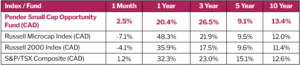
In July, the Fund returned 2.5%1, ahead of the S&P/TSX Composite at 1.2% and the Russell 2000, which declined -4.1%, in an eventful month for Canadian and international markets. Canadian markets saw significant divergence in July, characterized by a rotation into value stocks and energy, while growth-oriented segments and broader small-cap indices faced headwinds. Market sentiment was shaped by resilient Canadian labour data, escalating US-Canada trade tensions involving new 50% tariffs, and what we viewed as a broader shift away from AI-themed growth stocks.
Portfolio weights ~65.5% in Canadian equities and ~22.1% in US equities.
We have taken a more defensive position than in previous months, with cash and equivalents at approximately 18% of the portfolio. Year to date, markets have been dominated by a "risk-on" environment driven by, in our view, a historic surge in AI-related valuations — fuelled by significant hyperscaler capital expenditure and unrelenting investor appetite for growth-oriented technology stocks that frequently detached from cyclical fundamentals. By late July, however, this trade began to fade as investors shifted focus from pure growth toward capital efficiency.
A few warning signs have emerged: demand for the debt that funds AI infrastructure buildouts may be showing signs of exhaustion, with certain data-centre-related bonds weakening materially after issuance. At the same time, mortgage rates and Treasury yields have risen, and bond market weakness has historically acted as, in our view, a precursor to equity market volatility. Investors are also closely watching the capital expenditures of big tech companies as they reported earnings this month, on concerns that this spending could pressure margins if it doesn't translate into near-term earnings strength.
It appears that demand for high-beta names has shifted meaningfully, from a period of excitement and speculation driven largely by AI stocks, to a phase of cooling risk appetite and defensive rotation. Given this environment, we remain alert to a further move toward "risk-off" conditions, which could bring a spike in volatility indices and a widening of credit spreads. Our current defensive stance, including elevated cash reserves, is intended to provide the flexibility to move into high-quality businesses should liquidity needs create compelling opportunities.
Portfolio Holdings – Updates

Kinaxis was a top performer in the month as the company continues to execute on its next phase of growth. On July 20, 2026, Kinaxis appointed Herb Yeh as Chief Financial Officer and Chief Strategy Officer. Yeh, a veteran investment banker, is expected to help raise the company's global profile and lead more active capital allocation, including potential M&A. Following month-end, the company also released solid Q2 results, raising its full-year total revenue and SaaS revenue guidance. Backlog was up 18% year-over-year, and management noted an uptick in demand across the high-tech value chain amid ramping data center builds, as well as in the defence and aerospace vertical.
MDA Space was the top detractor of the month despite what we viewed as meaningful positive news. On July 9, MDA entered into an agreement to acquire a 70% majority interest in French satellite data analytics firm Collecte Localisation Satellites (CLS) for approximately $920 million in cash, funded in part by an US$819 million bought-deal financing at US$35.60/share. MDA said the deal builds on its investments in space observation, satellite ground stations, and data analytics, complementing CLS's existing satellite-based services. On July 23, the company also priced a private placement of C$600 million in 6.5% senior unsecured notes due 2033.
Following month-end, another monthly detractor, Telesat, announced it had signed the largest contract in its history — a $2.3 billion agreement with the Government of Canada to provide secure military connectivity in the Arctic for the Canadian Armed Forces. The agreement will also expand the fully funded Telesat Lightspeed constellation by 69 satellites, from 156 to 225, materially increasing its capacity and commercial potential. The expansion is supported by milestone-based government payments beginning next quarter. MDA will build the expanded constellation and has received a $474 million follow-on award covering 27 additional satellites, military Ka-band capabilities, and other long-lead items.

Outlook
Looking ahead, we remain cautious on broader market conditions despite recent strength and have shifted to a more defensive positioning as a result. That caution comes with a silver lining: significant infrastructure spending that we believe may occur over the next decade could create long-term opportunities across several sectors, even as near-term pressures weigh on large-cap and small-cap equities alike. Against that backdrop, we continue to seek out undervalued small-cap businesses with, in our view, strong economic characteristics trading at attractive valuations.
Pender Small Cap Opportunities Investment Team
August 12, 2026
1 All Pender performance data points are for Class F of the Fund. Other classes are available. Fees and performance may differ in those other classes. Standard Performance Information for the Fund may be found here: www.penderfund.com/fund/pender-small-cap-opportunities-fund/