
Chers porteurs et porteuses de parts,
The Pender Alternative Absolute Return Fund returned -0.5%1 in October bringing year to date return to 1.4%.
Wider credit spreads were somewhat mitigated by falling interest rates, but credit markets were highly bifurcated, with high yield investors crowding into issuers that were perceived to be high quality, while other issuers saw spreads blow out dramatically, sometimes on relatively little news.
The HFRI Credit Index hedged to CAD; the Fund’s benchmark returned -0.8% in October, bringing year to date returns to 1.7%
Several of the Fund’s positions that entered the month at relatively higher yields were hit hard in October. The most dramatic repricing occurred in bonds issued by Six Flags Entertainment Corp following the death of a patron at their Six Flags Over Georgia park. While we believe that the company’s asset value is well above their current debt load, the stakes for near-term operating performance have increased. We elected to sell most of our position in their bonds to reflect the higher risk profile for the company.
Risk premiums moved higher for high yield data centre bonds in October. Credit spreads for data centre bonds have been moving steadily higher since June, while the Nasdaq 100 Index hit a new all-time high in early October. The stark divergence between equity and credit markets treatment of the AI trade is unsustainable in our view. We saw some mean reversion very late in the month but believe there is potential room for data centre credits to significantly outperform the Nasdaq in the coming years.
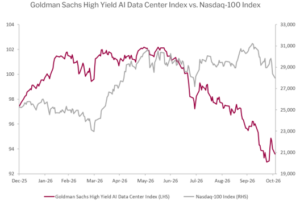
Source: Bloomberg/Goldman Sachs
Our credit exposure is entirely to facilities leased by mega-cap technology companies, not to “neoclouds” like CoreWeave Inc. (CRWV). For the credits we are exposed to in the Fund, we are not taking a view on the pricing of computing power or the useful life of GPUs that CoreWeave and SpaceX are taking in their neocloud business models. Ultimately, we are underwriting some construction risk for projects that are already being built and have contracted power agreements with local utilities. If the market’s view of AI as a business model were to change, the majority of tenants of the data centre we’re exposed to have dominant positions in legacy businesses not directly related to AI with strong cash flows. The one exception is Nvidia Corp. (NVDA) which, in our view, would certainly feel the impact of the AI trade rolling over but remains the clear market leader having generated over $100 billion in free cash flow in the past twelve months, and would be comfortably able to withstand an AI bear market.
As these projects get built, the construction risk will decline, improving the credit quality of our bonds. All of our high yield data center bonds are currently rated BB and may be well positioned for an upgrade to investment grade upon project completion, which we expect in the next eighteen months. Once the facilities are completed, these bonds will start amortizing at par. In some cases, our holdings trade at discounts to par of more than 10%. Finally, all our high yield holdings have maturity dates of less than five years and are callable at par a year prior to maturity. While it will be subject to the financing environment in early 2030, we believe that many of our holdings will likely be called at the par call date, resulting in a realized yield greater than yield to maturity.

By way of comparison, the ICE BofA BB US High Yield Index yield to worst of 7% at month end. We like being in secured data center bonds hedged with a short on the Nasdaq 100 given the very different levels of optimism being priced into credit relative to equities.
We saw a lot of higher yielding high yield bonds get hit disproportionately in October as CCC spreads hit their highest level since spring 2020. A large European based high yield hedge fund, Arini Capital Management had lost 12% in the month as of October 23rd and 26% year to date. It appears that their losses were driven by being exposed to many weaker distressed credits including troubled automaker Aston Martin. Bloomberg reported that they were actively selling large chunks of their better performing exposures to asset managers, including Oaktree and PIMCO.
A couple of our holdings got caught up in this hedge fund de-risking theme, most notably, our position in Rivian Holdings first lien bonds. Rivian’s bond closed the month yielding about 12%, up from about 10% at the end of September even after reporting better than expected Q3 results later in the month. The company is showing strong demand for their new, more affordable R2 SUV, has raised over $2 billion in equity capital this year, and has a market cap of $20 billion. We believe that getting paid a yield of 12% to own the top $1.25 billion of this capital structure is a compelling opportunity for the Fund.
Our Hilton Hawaiian Village CMBS holding paid out early in October, leaving us with hardly any CMBS exposure in the Fund. We’ll likely need to see a significant spread widening event for this asset class to make up a material portion of the Fund’s market exposure again.
Perspectives de marché
We might be nearing an inflection point for the AI trade. The repricing of risk premiums in credit markets means that key players like neocloud issuer CoreWeave no longer have access to unsecured high yield bonds and will need to rely on equity or convertible bonds to fund their cash flow deficits. The hyperscalers continue to access investment grade markets, albeit at significantly higher yields than in the past. There has not been a high yield data centre issue since September. We heard from both rating agencies and investment banks that issuance of data centre bonds was expected to be high this fall. While it is possible to bring a higher quality transaction to market, the riskier projects that were able to come to market in July and August are effectively shut out of the market.
The Democratic sweep of Congress along with gains at state and local levels likely means that it will be more challenging to develop AI data centres going forward. This should enhance the value of the projects that are already well advanced, while having a negative impact on AI-related equities where valuations require a long runway of future data centre buildouts.
The large divergence between credit and equity markets we’ve observed in recent months is reminiscent of several late-cycle environments from the past. In the late 1990s, credit markets never regained all the ground lost from various emerging market crises and the managed wind-down of Long Term Capital Management in 1998, while equities didn’t peak until early 2000. In 2007 credit spreads bottomed out in the spring, while equities peaked in October. We think the current market is more analogous to the late 1990s than 2007. Timing the exact inflection point is nearly impossible but considering the degree of strain in key areas of the credit market and that North American credit markets recently hit multi-decade lows in spreads, there is ample evidence that we are in a late-cycle environment.
Paramètres du portefeuille
The Fund finished October with long positions of 132.0% (excluding cash and T-bills). 32.6% of these positions are in our Current Income strategy, 98.1% in Relative Value and 1.3% in Event Driven positions. The Fund had a -65.7% short exposure that included -2.6% in government bonds, -40.5% in credit and -22.6% in equities. The Option Adjusted Duration was 2.62 years.
Excluding positions that trade at spreads of more than 500bp and positions that trade to call or maturity dates that are 2028 and earlier, Option Adjusted Duration declined to 1.59 years.
The Fund’s current yield was 6.88% while yield to maturity was 7.29%.
Justin Jacobsen
Gestionnaire de portefeuille
November 9, 2026
1 Tous les rendements signalés sont ceux des parts de catégorie F du Fonds. D’autres catégories de parts sont offertes. Celles-ci pourraient présenter des frais et des rendements différents. Les données standards sur le rendement du Fonds sont présentées ici : https://penderfund.com/fr/fund/pender-alternative-absolute-return-fund/
Les données standards sur le rendement des fonds alternatifs liquides de Pender sont présentées ici : https://www.penderfund.com/fr/
Ce commentaire comporte un Avis de non-responsabilité, que vous pouvez consulter ici : https://www.penderfund.com/fr/disclaimer/
© Copyright Gestion de capital PenderFund ltée. Tous droits réservés, novembre 2026.