Chers porteurs et porteuses de parts,
Le Fonds alternatif à rendement absolu Pender a affiché un rendement de -0,3 %1 in August, bringing year-to-date return to 1.5%.
A sharp rebound in risk assets that started in late July fizzled out in the middle of the month. Low issuance and low engagement in a late summer market helped support both credit and equity markets. Developing macro headwinds were mostly overlooked in August but could be a major factor as engagement and issuance pick up in September. High yield spreads hit their lowest level of the year in late August, pushed tighter by a sell-off in Treasuries without a commensurate sell off in high yield bonds.
The HFRI Credit Index hedged to CAD; the Fund’s benchmark returned 0.5% in August, bringing year-to-date returns to 3.7%.
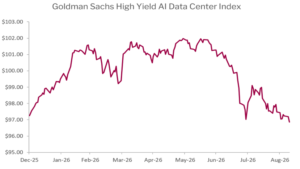
The bounce in shares of mega cap technology companies did not pass through to credit markets, where project level debt supported by leases from Magnificent Seven companies bounced modestly in early August before fading in the second half of the month and in many cases, making new lows in September.
Source: Bloomberg, Goldman Sachs
The Fund used the bounce in early August to sell some high yield data center exposure. Despite what we understood to be plans for several high yield data center issues in August, only one came to market, Zenith Arc LLC an Oklahoma project leased by Jane Street. Shortly after this deal was priced, it was reported that Jane Street lost $15 billion in July, mostly due to trades tied to AI and the Situational Awareness Fund. This development had a significant, negative impact on the bond which quickly lost three points and is currently trading more than seven points below issue price at the time of writing. The Fund did not participate in the Zenith Arc financing but did buy an Investment Grade rated project financing from QTS which will fund the buildout of new buildings at an established data center campus in Atlanta that is fully leased by Microsoft (Nasdaq: MSFT). This issue, QTS Central Issuer LLC priced with a 6.625% coupon and 2.5-point discount to par to yield about 7.2% to maturity in five years, trading up about one point from issue price as of mid-September.
We believe that data center bonds are a source of both risk and opportunity today. Our exposure is to hyperscaler leased facilities in good locations that are well advanced. There are multiple risks to investing in data center credits today, from tenant quality and overbuilding to community and political opposition. With the sharply negative performance of several new issues over the past few months, the pipeline for high yield data center deals is uncertain. Lower quality projects might discover that the market has effectively closed to them for now.
The Fund reduced energy exposure in August. Our large position in Sunoco 6% 2028 was called, and we also took sales in several positions with limited upside due to tight spreads or near-term calls. Much of our official energy weight remains in Enbridge Inc. commercial paper which we view as a cash equivalent more than a true risk exposure. Due to the lack of attractive spread, we have elected to let some of our Enbridge exposure roll off in September, further reducing our energy weight.
With Treasury yields moving higher we have taken our duration up modestly in recent weeks. We view Canada two-year bonds as an attractive cash substitute, with a yield of roughly 3.4% at the time of writing. This compares with the current Bank of Canada policy rate of 2.25%. Considering the state of the Canadian economy, particularly the Canadian real estate market, we believe that the Bank of Canada is unlikely to hike as much as is currently priced into the market.
Much of high-quality high yield has been driven to exceptionally tight spreads by the latest move higher in interest rates. We believe that the market risk is elevated today and are positioned accordingly. We expect that volatility and trading opportunities will pick up this fall.
Perspectives de marché
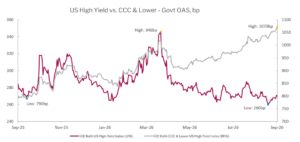
High yield spreads hit a low of 260bp Govt OAS on August 31st, just 1bp away from the January 2025 low of 259bp which was the lowest spread level since 2007. Much like both the 2025 and 2007 low in spreads, the bottom in spreads coincided with a spike in treasury yields that took time to be transmitted to high yield prices. Unlike other major spread bottoms which coincide with decreasing credit spreads across the quality spectrum, CCC spreads have been moving wider for most of the past year and are currently at levels usually seen at periods of real market stress.
Source : Bloomberg
This degree of bifurcation in credit markets at a time where significant lows in risk premiums are being made at the index level is unprecedented as far as we can tell. The move in CCC spreads strongly suggests that defaults are likely to pick up at the lower end of the credit spectrum, and that access to capital is limited for overleveraged balance sheets. Public markets won’t be the outlet for problem credits in private debt markets, where a default cycle is also likely to pick up. Finally, with generic spreads being as tight as they are while both CCC and data center risk premiums increase significantly, the spread compensation for owning high-quality high yield bonds is the lowest in decades. Much of the market that is currently priced as high quality includes small cap and cyclical credits that have melted up with the market. We have short positions in several of these issuers.
We believe that the August low in spreads will likely be the low for the year, and that major bottoms in spreads often precede significant volatility episodes in the following six months. There are a number of building risks at the macro level, perhaps most importantly increasing treasury yields, which should ultimately reprice all asset classes, especially those whose valuations are reliant on longer dated cash flows.
With opportunities already increasing, we are optimistic that an extended period of low volatility is coming to an end and expect the Fund to be more active in markets for the balance of the year.
Paramètres du portefeuille
The Fund finished August with long positions of 127.0% (excluding cash and T-bills). 28.4% of these positions are in our Current Income strategy, 97.4% in Relative Value and 1.2% in Event Driven positions. The Fund had a -71.3% short exposure that included -4.0% in government bonds, -44.5% in credit and -22.8% in equities. The Option Adjusted Duration was 1.46 years.
Excluding positions that trade at spreads of more than 500bp and positions that trade to call or maturity dates that are 2028 and earlier, Option Adjusted Duration declined to 1.19 years.
The Fund’s current yield was 5.81% while yield to maturity was 6.22%.
Justin Jacobsen, CFA
Gestionnaire de portefeuille
September 16, 2026
1 Tous les rendements signalés sont ceux des parts de catégorie F du Fonds. D’autres catégories de parts sont offertes. Celles-ci pourraient présenter des frais et des rendements différents. Les données standards sur le rendement du Fonds sont présentées ici : https://penderfund.com/fund/pender-alternative-absolute-return-fund/
Standard Performance Information for Pender’s Liquid Alternative Funds may be found here: https://www.penderfund.com/fr/
Ce commentaire comporte un Avis de non-responsabilité, que vous pouvez consulter ici : https://www.penderfund.com/fr/disclaimer/
© Copyright Gestion de capital PenderFund ltée. Tous droits réservés, septembre 2026.