
A small rule change is giving retail investors outsized influence over market volatility.
Working through market commentaries recently, the same word kept coming up: volatility. Generally speaking, that's usually in reference to oil, inflation, rates... the standard. But I came across an article in Barron's that introduced a new name to the list of volatility drivers, and this kind comes from someone (or a lot of someone's) with $2,000 and a trading app.
Markets have provided plenty of volatility lately. Today's environment is characterized by a significant and widening bifurcation. Mix in an energy supply shock, re-accelerating inflation, ongoing questions about AI spending sustainability and higher-for-longer monetary policy regimes, and let's just say it's mayhem in the marketplace. All the usual suspects, essentially. But there's a newer force at work too, one based on individual stocks rather than the broader macro picture.
Let's start with a stat: margin debt hit a record high of $1.5 trillion, up 49% from a year ago, according to the Financial Industry Regulatory Authority.
How about another: average volatility across a basket of 20 popular retail stocks has increased by 80%, relative to the same period last year. Even in tickers where institutions own a vast majority of the outstanding shares, small investors are proving capable of creating major swings in price action.
So, what's going on?
A Dot-Com era rule that previously restricted margin access for high-frequency traders to those with account balances of $25,000 or more has gotten a revamp. Recently, a new margin framework replaced the 25-year-old pattern day trader rule. Under the new intraday margin rule, retail traders can now execute unlimited day trades on margin with account balances as low as $2,000, granting smaller, less-capitalized accounts far greater access to leverage.
Webull CEO Anthony Denier said during the company's first-quarter earnings call in May that he expects the elimination of the pattern day trader rule to eventually boost trading volume by at least 20%.
Although the new rules were met with excitement from retail investors, not all is well on the home front. When a trade goes wrong or markets turn quickly, traders operating with only a few thousand dollars in their accounts have fewer resources to meet margin calls, increasing the risk of forced selling during market declines. That vulnerability is growing as volatility rises across many heavily traded retail stocks, where sharp price moves make margin calls more likely.
Even in a zero-commission environment, smaller, less experienced traders lose money due to a variety of factors: overconfidence in their information and abilities, volatility, and the reality that other market participants are better equipped to seize profitable trades and liquidity in seconds.
Not to mention the impact of everyone's favourite Reddit forum, WallStreetBets. Stocks including Micron Technology, Sandisk and AST SpaceMobile, all popular among retail traders on forums like WSB, have experienced sizable increases in volatility amid growing retail participation. Look back at what happened in prior years to stocks like GameStop, or even closer to home, BlackBerry. With these new leveraged opportunities in place, the future doesn't necessarily look that friendly.
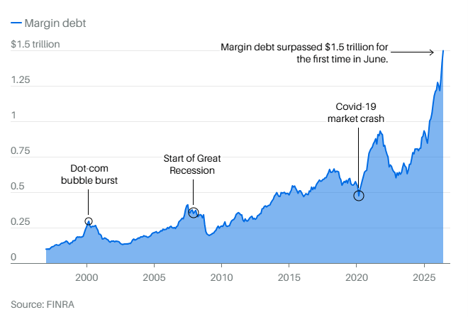
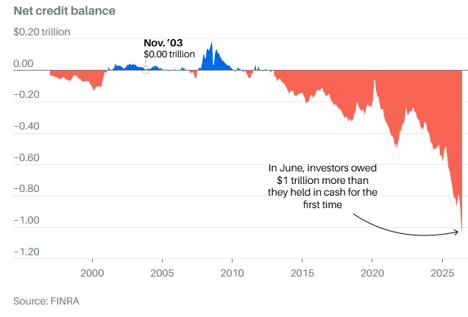
If you want a preview of where unchecked retail leverage can lead, look no further than South Korea. The intense volatility rocking their chip-heavy stock market offers a preview of how heavily leveraged retail participation can amplify market moves. So far, Wall Street has only suffered modest losses by comparison. The question is whether this is just noise, or whether the semiconductor slump and vulnerability among highly leveraged investors eventually catch up to additional markets as well.
Regulators in Seoul have ramped up efforts to curb wild swings in equity prices, fuelled in part by heavily leveraged retail investors using ETFs. These investors were pulled in by the extraordinary AI boom, and many have been caught out by the rapid snapback.
According to Goldman Sachs, more than 1.2 million leveraged retail trading accounts in South Korea triggered margin calls during a recent period, with an estimated 320,000–360,000 accounts fully liquidated. Goldman's strategists reckon this means around one in 30 adults in the country, or 3.4% of the adult population, have received margin calls.
That could have a meaningful impact on Korea's economy more widely. If many South Korean households are now sitting on losses, that could weigh on the country's economy moving forward. Given rising retail participation in U.S. stocks, exposure to the AI theme and the growing popularity of leveraged vehicles: could Wall Street, and the broader economy, be next?
The market has handed smaller traders a bigger lever to pull at a time when macroeconomic uncertainty remains elevated. If this is what volatility looks like in a relatively normal market environment, what happens when a major shock arrives?
Veuillez lire les avis de non-responsabilité importants à www.penderfund.com/fr/disclaimer/.
Les données standards sur le rendement des fonds Pender sont présentées ici : www.penderfund.com/solutions/