Market Update
One phrase that I feel is true more often than not is, “markets will do what makes the most people wrong". This August seems to have captured that phrase perfectly. During what is normally one of the quietest and most volatile parts of the calendar, anyone who stepped to the sidelines missed one of the better months of the year.
2026 has not gone anywhere close to expectations. It was expected to be a year of rate cuts and falling inflation, but the Iran war and higher oil prices have derailed that plan, pushing bond yields higher. Yet, even with that backdrop, it hasn’t been a bad year for financial assets.
If someone had told you in January that bond yields would be at cycle highs by September, most would have predicted a negative outcome for equity markets. However, that hasn’t been the case, as equity markets ended August near all-time highs.
What has helped to support markets has been a steady supply of capital. When inflation is high, the worst thing investors may do is hold cash. To maintain purchasing power, investors likely need to stay invested in assets that will earn a return higher than inflation. This has helped to keep a bid to all asset classes.
One huge positive this year is that corporate earnings have come in much stronger than expected. With valuations near record levels, earnings needed to surprise to the upside for prices to move higher, and that is exactly what happened. Another positive is that this isn’t just AI-driven, as it has been in recent years. Corporations across many sectors are taking advantage of growth opportunities.
But it’s not all clear sailing. The bond market is sending out warning signs that investors need to pay attention to. Yields moving higher could eventually have an impact on highly levered governments and individuals. In our view, this will slow growth. The fact that the US Treasury intervened during the month in an attempt to lower yields at the long end of the curve can’t be looked at as a positive.
One asset class that has caught on to this risk is gold. Precious metals have had a wild two years but saw gains in August. Investor demand is picking up, with record flows into related ETFs, while central banks have picked up purchases. The role of gold in a portfolio is to be a store of value, and with increased uncertainty ahead, it appears ready to do its job.
Heading into the fall, we don’t expect volatility to subside. The US-Iran war looks far from settled, which will likely keep energy prices higher. That will make it very difficult for Central banks to keep yields lower to help consumers. Add on top of that trade wars and an uncertain US election season and investors have every reason to lock in some hard-earned profits. Unless everyone has already done that? Which makes for a tricky environment. If everyone has already sold, what will make the most people wrong is a further run into year end.
Performance
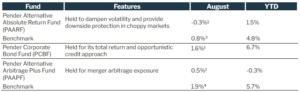
The Pender Alternative Multi-Strategy Income Fund was up 0.6% for August and has returned 3.0% YTD1. The Fund's blended benchmark has returned 1.2% and 4.1%2 for the same periods respectively.
Portfolio Positioning
The Pender Alternative Absolute Return Fund and the Pender Corporate Bond Fund are the largest holdings in the Pender Alternative Multi Strategy Income Fund at 38.3% and 39.1% respectively. We view this as a defensive stance reflecting our concerns that market volatility could increase into year end.
In addition to our positioning, the underlying Funds have increased cash levels and taken down market exposure. With higher bond yields and tight credit spreads, our portfolio managers view this as a less than attractive environment for risk-taking.
We will look to increase exposure once the macro environment improves. If energy prices begin to stabilize and bond yields fall, we will adjust accordingly to take advantage of opportunities.
Greg Taylor, CFA
CIO and Portfolio Manager
September 17, 2026
1 All Pender performance data points are for Class F of the Fund. Other classes are available. Fees and performance may differ in those other classes. Standard Performance Information for the Fund may be found here: https://penderfund.com/fund/pender-alternative-multi-strategy-income-fund/
2 The Fund’s blended benchmark consists of 9% FTSE Canada Universe Bond Index, 25% ICE BofA US High Yield Index, 33% HFRI Credit Index (Hedged to CAD), 33% HFRI ED: Merger Arbitrage Index (Hedged to CAD)
3 The benchmark used is the HFRI Credit Index (USD). The Fund’s benchmark is the HFRI Credit Index, hedged to CAD.
4 Benchmark HFRI ED: Merger Arbitrage Index (USD)
Standard Performance Information for Pender’s Liquid Alternative Funds may be found here: https://www.penderfund.com
This commentary is subject to the Disclaimer found here: https://www.penderfund.com/disclaimer/
© Copyright PenderFund Capital Management Ltd. All rights reserved. September 2026.