Remember when August was a month to take a break and relax? Markets certainly disagreed with that idea … instead of long summer days of leisure, investors were met with volatility and broad-based doubt about what the fall season could hold.

Portfolio weights are 42.7% US equities, 32.4% Canadian equities and 13.5% international equities.
August was marked by swings in sentiment driven by a series of data releases and announcements. A combination of inflation readings, an oil price jump tied to the ongoing conflict in the Strait of Hormuz, and central bank policy debates kept global interest rates at the centre of discussion. Rates rose around the globe, and expectations increased for more central bank activity. International markets experienced a similar level of volatility, driven by many of the same factors. Commodities also gained, led by agriculture, as worries mounted over the potential impact of the El Niño climate pattern.
In the US, new Fed Chair Kevin Warsh delivered more hawkish comments than expected at the annual Jackson Hole economic symposium, emphasizing that inflation isn't slowing quickly enough, and markets responded by pricing in a greater likelihood of a rate hike in September. As a result, interest rate discussions dominated market sentiment for much of the second half of August. Some strategists expressed concern that the market is shifting from being earnings-driven to being driven by the Fed, inflation, and interest rates. A dynamic likely to keep volatility a persistent feature of markets into year end.
That said, the trepidation didn't carry over into US equities, which rallied on strong earnings from some of the biggest technology companies, a sign the AI trade is still alive and well, unlike earlier in the year, when the resiliency of the theme was questioned amid concerns over massive AI capex spend.
For long-term investors like us, this type of environment reinforces the need to stay focused on our long-term theses. While volatility has remained constant, we continue to focus on the controllables rather than trying to predict the next market swing. With mid-term elections approaching and other potential catalysts ahead, we remain ready to navigate more uncertainties.
Fund Specific Updates (August)

MapleBear (Instacart) – Was a top contributor in the month following another solid quarter, with gross transaction value increasing 14% y/y, marking its 10th consecutive quarter of double-digit growth. Advertising revenue increased 16%, and adjusted EBITDA exceeded guidance. The company also highlighted the continued expansion of its retail partnerships beyond traditional groceries, and a deepening commitment to AI to reduce order friction and increase basket sizes.
VitalHub Corp. (VHI) – Was another top contributor in the month. The company reported earnings broadly in line with expectations, crossing the milestone of $100 million in Annual Recurring Revenue (ARR). VitalHub ended the quarter with over $130 million in cash, and management announced an NCIB to buy back nearly 5% of shares. Management noted that the company's strong cash position allows it to pursue both share buybacks and its M&A strategy simultaneously.
Deckers Outdoor Corp. (DECK) - Was a detractor in the month. Despite beating Q1 estimates and raising full-year guidance in July, shares had already come under pressure on margin and tariff concerns heading into August. That pressure was compounded when other athletic footwear/apparel retailers reported disappointing quarters, and the read-through hit the whole group. JD Sports warned of weaker core sentiment, a slow quarter for high-heat footwear products, and deferred back-to-school demand, with shares dropping more than 13%. Dick's Sporting Goods stock fell 30.7% on August 25 (its worst day ever) after Q2 earnings missed and it cut full-year guidance. Despite this sector’s weakness, our thesis on the name hasn't changed.
StandardAero Inc. (SARO) - Was another detractor in the month, despite reporting a solid quarter that came in ahead of Street expectations and management raising full-year guidance. SARO announced a $180 million license expansion with a key OEM partner covering multiple turbofan and turboprop platforms; the company expects the investment to contribute approximately $10 million of incremental adj. EBITDA in 2027, rising to $20 million in 2028 and roughly $25 million annually thereafter. Despite this, the stock sold off in the month, with investors seemingly more focused on the pace of top-line growth and mixed segment performance than the margin and guidance beat. It's also worth noting that, following month-end, CEO Russell Ford announced his retirement after 13 years, with Lead Independent Director Paul McElhinney set to succeed him effective October 1.
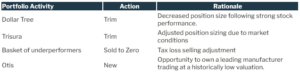
Otis Worldwide Corp. (OTIS) – We added a new name to the fund in Otis, the world's leading elevator and escalator manufacturer, installer, and servicer. Otis operates in two segments: New Equipment and Service with an installed base that is growing 3-4% per year. In our view the company should be able to grow FCF by 9% per year over the next five years on top of a 38% ROIC generated over the last decade. We believe Otis's moat has also widened through its investment in technology, resulting in a stickier customer base. We saw an attractive opportunity to enter the name when the stock was trading at a historically low 7% 2027E FCF yield.
Pender Small Cap Equity Team
September 16, 2026
1 All Pender performance data points are for Class F of the Fund. Other classes are available. Fees and performance may differ in those other classes. Standard Performance Information for the Fund may be found here: https://penderfund.com/fund/pender-global-small-mid-cap-equity-fund/
Standard Performance Information for Pender’s Liquid Alternative Funds may be found here: https://www.penderfund.com
This commentary is subject to the Disclaimer found here: https://www.penderfund.com/disclaimer/
© Copyright PenderFund Capital Management Ltd. All rights reserved. September 2026.