
Why sometimes process matters more than performance.
One of my go-to podcasts is How I Built This, where Guy Raz interviews some of the world’s best-known entrepreneurs about how they built their companies. I’ve been a listener for years, partly for the human side of it: the real, unpolished moments of doubt and failure that sit alongside eventual success. It humanizes founders in a way that few business books can.
The question I always look forward to comes at the end of each episode: how much of their success would they attribute to luck versus skill?
The answers vary as much as the backgrounds of the guests themselves. Shopify founder Tobias Lütke once put it at 90% luck, comparing his timing to winning the lottery five times in a row. Away co-founder Jen Rubio called it a 50-50 split between luck and hard work. Bumble founder Whitney Wolfe Herd rejected the premise altogether, saying she wasn’t sure she would describe any of it as luck.
I’ve thought about that discrepancy often. So many founders, so many different answers, all defensible.
The question fascinated me enough that when Guy Raz published How I Built This: The Unexpected Paths to Success from the World’s Most Inspiring Entrepreneurs, I bought a copy immediately. I was pleased to discover he’d spent a great deal of time thinking about the same question.
Raz frames luck and skill not as opposing forces but as an interconnected loop. Skill allows people to recognize luck when it appears and, more importantly, do something with it. Timing and circumstance matter, but expertise, persistence, and judgment create the conditions that allow opportunity to be captured when it arrives. He calls it the “lucky-and-good” feedback loop.
More recently, I revisited Michael Mauboussin’s work on the same dilemma. For those unfamiliar, Mauboussin is Head of Consilient Research at Counterpoint Global, Morgan Stanley Investment Management, an adjunct professor at Columbia Business School, and something close to a house philosopher here at Pender.
His paper Untangling Skill and Luck, later expanded into The Success Equation, offers one of the most rigorous treatments of this question I’ve encountered. Guy Raz asks it from the founder’s chair; Mauboussin approaches it through statistics.
The more I sit with the idea, the more I think it may be one of the most important concepts in investing and in life.
The Paradox
Before going further, it’s worth defining the terms.
Skill is the ability to use knowledge effectively in pursuit of a goal. Luck is the collection of events and circumstances that operate for or against us.
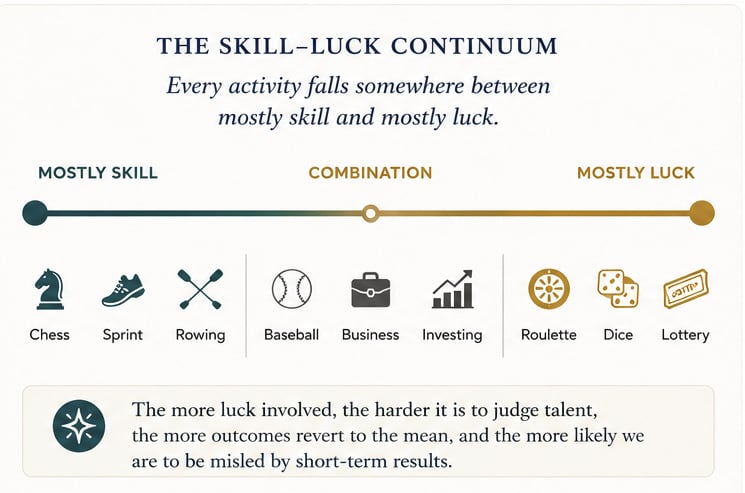
Mauboussin offers a simple test that may explain the difference better than any dictionary definition: can you lose on purpose?
If you can’t, luck dominates the activity. If you can, skill plays a meaningful role.
Roulette is almost entirely luck. Chess is overwhelmingly skill.
Investing sits somewhere in the middle, which is precisely what makes it so difficult.
It’s comforting to believe success is mostly luck. That suggests the biggest winners simply caught the right break. It’s equally tempting to believe success is entirely earned through grit, discipline, and judgment.
Reality is far less satisfying.
What we do know is that we are wired to reverse-engineer outcomes into explanations. We see a great result and assume it came from a great process. We see a poor result and assume poor decision-making was responsible.
Often, neither conclusion is correct.
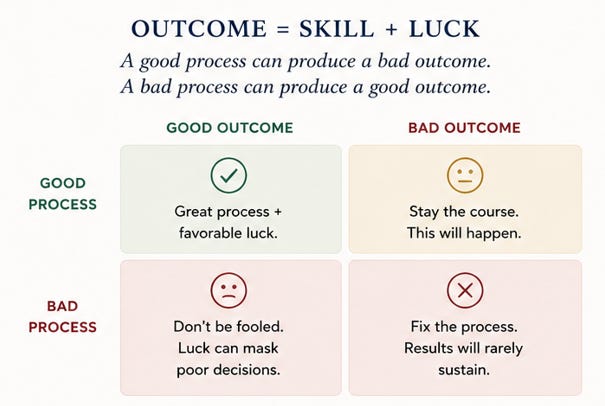
Sometimes great decisions lose. Sometimes terrible decisions win.
This is especially true over short time horizons, which are often the only horizons people watch.
That’s the paradox in a sentence. As Mauboussin puts it, a good process can produce a bad outcome, and a bad process can produce a good one.
For an industry that is often judged quarterly, that can be a difficult idea to accept.
Converted from Michael J. Mauboussin “Untangling Skill and Luck How to Think About Outcomes—Past, Present, and Future”
The Beautiful Game(s)
This line of thinking resurfaced while we were preparing this summer’s World Cup content series. Investing is a fascinating place to think about the skill-luck debate, but sports may be the best laboratory because it unfolds in real time.
My beloved Cabo Verde Blue Sharks, representing a nation of roughly 500,000 people, became the smallest country ever to reach the knockout round while holding Spain to a scoreless draw along the way. Their run ultimately ended on a deflected header in extra time against Argentina, the sort of moment that gets called brilliant defending when it bounces one way and bad luck when it bounces the other.
Brazil’s tournament exit offered another reminder. A saved penalty here, a late goal there, and the entire shape of the competition changes. Small moments alter careers, narratives, and legacies.
That’s part of what makes sports so compelling. Randomness is visible.
A shot two inches to the left and nobody remembers it. Two inches to the right and someone becomes a hero.
Separating luck and skill after the fact is rarely as easy as it seems.
Converted from Michael J. Mauboussin “Untangling Skill and Luck How to Think About Outcomes—Past, Present, and Future”
Why Our Brains Get This Wrong
This is where behavioural finance enters the conversation.
Decades ago, psychologists Amos Tversky and Daniel Kahneman described what they called the “law of small numbers” — our tendency to draw sweeping conclusions from limited evidence.
Five winning trades. One strong year of performance. A short winning streak.
None of these tell us nearly as much as we think they do.
This was essentially the premise behind Moneyball. Billy Beane’s insight wasn’t that he understood baseball better than everyone else. It was that many of the statistics people relied upon were noisy, while a handful of less glamorous metrics were actually predictive.
The distinction between signal and noise matters.
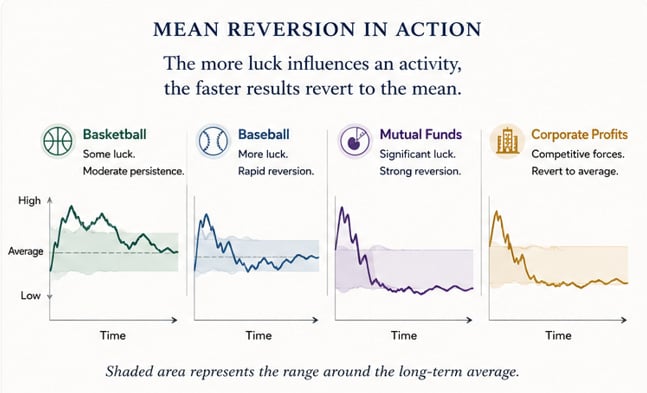
The same challenge exists in investing. One-year returns are noisy. A disciplined process is far more persistent.
The problem is that, in the moment, the two often look identical.
Another bias compounds the issue: the illusion of control, our tendency to believe outcomes are more within our control than they really are.
We see it everywhere. People repeatedly press a crosswalk button that has already been activated. Athletes cling to rituals. Investors attribute every success to insight and every failure to bad luck.
The feeling of control and the reality of control are not the same thing, however much us control freaks might wish otherwise.
Converted from Michael J. Mauboussin “Untangling Skill and Luck How to Think About Outcomes—Past, Present, and Future”
Where Does This Leaves Us?
If luck matters so much, what role is left for skill?
Mauboussin breaks it into three categories.
Analytical skill involves identifying mispriced expectations, not simply finding good companies.
Behavioural skill requires independent thinking, intellectual curiosity, and the ability to remain probabilistic rather than certain.
Organizational skill involves building the structure and culture necessary to stick with a sound process through periods when it isn’t producing the desired outcome.
That final category may be the most important of the three.
A good process only works if you are willing to follow it when it becomes uncomfortable.
So how much of success comes from skill, and how much comes from luck?
I don’t think we’ll ever fully untangle it, and I’m suspicious of anyone who claims they have. Ask Tobias Lütke, Jen Rubio, and Whitney Wolfe Herd, and you’ll get three completely different answers to the same question.
What we can say is that luck always matters, in both directions, and the only lever anyone actually gets to pull is process.
Perhaps that’s the real paradox: we spend enormous energy trying to predict outcomes when the only thing really worth mastering is the quality of the decisions that lead to them.
Please read important disclosures at www.penderfund.com/disclaimer.
Standard performance data for Pender Funds can be found at www.penderfund.com/solutions/