
Dear Unitholders,
The Pender Alternative Absolute Return Fund returned 0.3%1 in September bringing year to date return to 1.8%.
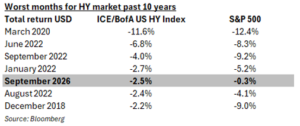
A historic spike in interest rates resulted in the US high yield market recording its worst monthly return in four years. Market returns were driven by a combination of sharply higher treasury rates as well as wider spreads
The HFRI Credit Index hedged to CAD; the Fund’s benchmark returned -1.1% in September, bringing year to date returns to 2.4%.
The divergence between equity and credit markets is the widest it has been in many years. The Nasdaq hit a new all-time high in September at the same time that risk premiums rose significantly for data centre bonds backed by long-term leases from some of the Nasdaq’s largest and strongest companies. The AI capital-expenditure cycle has inflated earnings and has become highly dependent on credit markets at current spending levels. We do not believe that increasing cost of capital can be ignored by the market for much longer.
We view our data centre exposures as some of the best value in credit markets today, with yields ranging between 7.5% and 10% for project bonds with long-term leases in place from Nvidia, Google, Meta, Microsoft and Amazon. Almost all our holdings mature within five years, with call options and amortization payments at par before then, shortening the effective maturity further. Future data centre projects are facing significant opposition, even in jurisdictions that are typically viewed as being business friendly. With the projects we’re exposed to well advanced, the value of a project that is approved and under construction could increase if demand for compute continues to exceed supply.
The Fund has no exposure to either Oracle or Coreweave, which we view as the swing producers of compute capacity this cycle. In our view, large spending booms can result in excess capacity and stranded assets. Our approach is to limit our exposure to data centres where the tenants have dominant businesses with or without AI.
September saw heavy high yield issuance as the two largest high yield bond issues ever both came to market. First was Softbank with an $11 billion issue to fund their previously committed purchase of OpenAI shares, followed by Paramount Skydance’s acquisition financing for Warner Brothers Discovery, which included about $14 billion of high yield bonds in addition to large investment grade bonds and leveraged loans. We participated in the Softbank issue before monetizing at a small profit in October. We did not participate in the Paramount Skydance issue which we believe relied on an overly optimistic target for synergies.
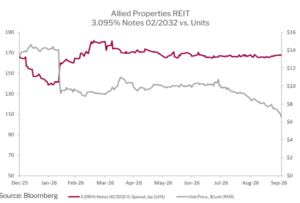
We are seeing increased opportunities in US high yield bonds as risk sentiment has deteriorated in many market sectors, while some sectors remain surprisingly resilient. The Canadian investment grade bond market has not seen nearly the level of repricing we’ve seen in riskier segments of US high yield, even for issuers facing significant cyclical headwinds. One example is Allied Properties REIT (TSX: AP.un), which has the lowest possible investment grade rating from DBRS, and is not rated by major US rating agencies. Previously, the company had a high yield rating from Moody’s that was withdrawn at the REITs request, allowing their bonds to migrate to the investment grade market. It has been a brutal year for the unit price of the REIT, trading down nearly 60% year to date, while credit spreads have barely moved. We believe that there is much more risk to Allied’s credit than is being priced in by the market:
We have seen an uptick in DBRS only issuers over the past two years in the Canadian credit market. In virtually every case, additional ratings from US agencies would have rated the same credits lower. We believe this is generally reflective of a loose underwriting environment that happens after a relatively extended period of low-risk premiums. We suspect that once the credit cycle definitively turns, investors will be much less accepting of a DBRS only rating.
Following the call of our holding in Secure Energy Services in September our energy weight continues to decline. We expect our holding in Athabasca Oil Corp.’s bonds to be called late this year in connection with their acquisition by Cenovus.
Market Outlook
The divergence between credit and equities is stark today. CCC spreads reached their highest level since spring 2020 in October.
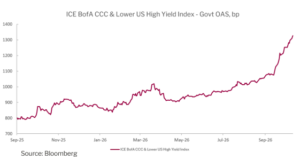
We believe the closest comparison to the divergences we are seeing today is the late 1990s cycle. Equities were even further dislocated from credit then, but much like today, equity market breadth was poor as one sector dominated. At that time, leveraged credit markets were relatively small and undeveloped. Today many investment mandates have flexibility to invest across capital structures, combined with the impact of large exchange traded credit index ETFs there should be a closer connection between equity and credit markets today than there was thirty years ago.
Despite a weak technical backdrop for credit, we believe that time is on the side of fixed income investors today. The US high yield market has a yield well into the 8s and a duration of around three years. While there certainly is the possibility that generic spreads could widen materially from here, at yields around 1% higher than current levels, we believe that the value in high yield would become compelling. After the peak of the dot com bubble, fixed income markets outperformed equites by a large margin in the ten years that followed, we could be approaching a similar set up in the coming quarters.
Portfolio Metrics
The Fund finished September with long positions of 143.2% (excluding cash and T-bills). 32.7% of these positions are in our Current Income strategy, 109.2% in Relative Value and 1.3% in Event Driven positions. The Fund had a -68.2% short exposure that included -2.5% in government bonds, -42.4% in credit and -23.3% in equities. The Option Adjusted Duration was 2.63 years.
Excluding positions that trade at spreads of more than 500bp and positions that trade to call or maturity dates that are 2028 and earlier, Option Adjusted Duration declined to 1.94 years.
The Fund’s current yield was 7.38% while yield to maturity was 7.72%.
Justin Jacobsen, CFA
Portfolio Manager
October 28, 2026
1All Pender performance data points are for Class F of the Fund. Other classes are available. Fees and performance may differ in those other classes. Standard Performance Information for the Fund may be found here: https://penderfund.com/fund/pender-alternative-absolute-return-fund/
Standard Performance Information for Pender’s Liquid Alternative Funds may be found here: https://www.penderfund.com
This commentary is subject to the Disclaimer found here: https://www.penderfund.com/disclaimer/
© Copyright PenderFund Capital Management Ltd. All rights reserved. October 2026.