
When a chief executive steps down, markets react quickly. Shares jump (or fall). Commentators debate whether the change signals renewal or crisis. Investors begin assessing the next “star” who might reignite growth.
But leadership transitions rarely hinge on a leader’s charisma alone. Over time, the companies that endure are not built on stars ... but systems.
Consider the West Coast’s favorite athleisure retailer, Lululemon. LULU has been on something of a hero’s journey -- specifically, the abyss portion. Periods of slowing growth and margin pressure have revived old questions: Has the brand lost momentum? Does the company need new leadership to restore its edge?
Lululemon’s previous CEO Calvin McDonald stepped down in January 2025. The market liked the news. Shares, previously down roughly 50% year-to-date, jumped 10%.
Yet, the deeper issue is rarely a single individual.
In retail especially, there is a constant tug-of-war between brand strength, macroeconomic conditions, and sustainable growth. Fashion is cyclical. Macroeconomic pressure come and go; tariffs rise and fall. A strong quarter can mask structural issues; a weak one can obscure enduring advantages.
Leadership matters, of course. But its impact depends on whether the organisation itself is capable of sustained execution.
A tale of two timelines
Lululemon’s margins told a tale of two timelines in the quarter leading up to McDonald stepping down.
Gross margin fell 290 basis points to 55.6%, while operating margin declined 350 basis points to 17%. Management cited higher tariffs and increased markdown activity as the primary culprits. Inventory ended the quarter up 11% year-over-year to $2.0B, which cuts both ways: higher promotional risk if demand softens, or optionality if holiday demand surprises to the upside. Looking ahead, management was candid about margin pressure:
“In terms of 2026 operating margin, it is fair to assume that the negatives will outweigh the positives… This will be our first full year of tariffs, and while we are working on offsets, margin recovery will be a multiyear effort.”
The company outlined a more formal action plan focused on three pillars: product creation, product activation, and enterprise efficiency, with the most meaningful benefits expected in 2026.
Now the real debate is whether Lululemon’s slowdown is cyclical, structural, or even cultural. There is a strong case for cyclical pressure: macro uncertainty, tariffs, FX headwinds, and cautious consumers. None of these fundamentally erode the brand. Competition from Alo, Vuori, or even Nike has not broken Lululemon’s moat, and its success in China shows its global relevance.
Yet the stock continues to slide. A CEO stepping aside amid turbulence is rarely comforting — and it is certainly not the mark of what Ben Horowitz would call a "wartime CEO." As we have questioned before, is it possible for a star leader truly transform a languishing brand? Does long-term success hinge on a single individual -- or is the story broader than that?
If you believe it is the latter, it is worth revisiting Domino’s Pizza.
Domino’s: a turnaround built on systems
A useful comparison comes from Domino’s Pizza. In 2010, Domino’s was a fading legacy brand. Customer perception was poor, the product was uninspiring, and growth had stalled. Enter Patrick Doyle, a longtime insider elevated to CEO. Doyle did not chase cosmetic brand refreshes or quick financial fixes. Instead, he confronted the core issue head-on , openly admitting the pizza was not good enough ... and rebuilt from there.
The lesson was not that a single leader performed a miracle. It was that leadership catalysed organisational change.
Doyle recognised that Domino’s true competitive edge would come from eliminating friction. The company invested aggressively in owning its technology stack, rolling out a proprietary point-of-sale system and relentlessly simplifying the ordering experience. One-click ordering. Saved profiles. Mobile apps. Voice ordering. Cars, watches, TVs, smart assistants. Domino’s met customers wherever they were.
Digital orders ballooned to nearly two-thirds of transactions, average ticket sizes increased, franchisee economics improved, and unit volumes climbed meaningfully. Importantly, this was not achieved by squeezing operators or cutting corners, it was driven by higher sales and better systems.
The results were extraordinary:
- Nearly three decades of consecutive same-store sales growth
- System sales nearly doubled
- Domino’s became the #1 pizza brand globally by sales
- The stock rose more than 2,000% during Doyle’s tenure
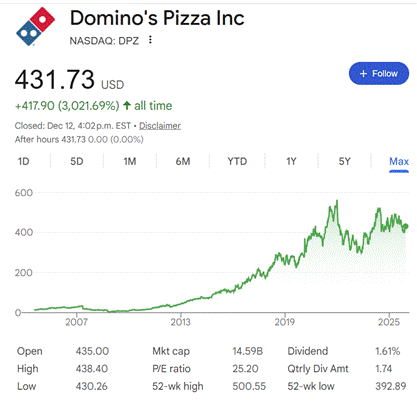 |
Source: Google Finance
Domino’s did not just fix itself, it reset consumer expectations for the entire restaurant industry.
A small but important caveat: leadership impact is not always perfectly portable. In November 2022, Doyle became Executive Chairman of Restaurant Brands International (TSX: QSR). The market response was immediate and enthusiastic, despite him not stepping in as CEO. Yet, to date, the QSR turnaround narrative has been far less compelling than the Domino’s story -- at least so far.
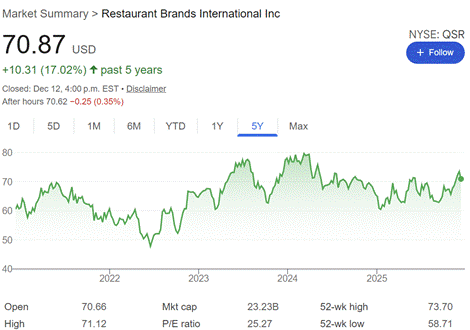 |
Source: Google Finance
That contrast is telling. It reinforces the idea that while great leaders’ matter, outcomes are shaped just as much by context, organizational readiness, and the ability to execute a coherent system-wide strategy. Dominos was primed for operational reinvention; QSR’s challenges are structurally different.
The same dynamic appears across industries. The Coca-Cola Company has navigated multiple leadership transitions over decades while maintaining brand dominance. No single executive defines its resilience. Governance structures, distribution networks and incentive alignment do.
Why this matters for Lululemon
Patrick Doyle was not a flashy outsider or a “celebrity CEO.” He was a disciplined operator who understood that sustainable turnarounds are built on process, culture, and execution, not slogans. Domino’s success was not about a single bold idea, it was about many unglamorous decisions, compounded over time, that removed friction for customers and operators alike.
In strong organisations, strategy is institutionalised. Product development pipelines are disciplined. Capital allocation frameworks are clear. Incentives align management with long-term shareholders. Culture reinforces decision making standards. In such environments, leadership transitions may alter tone, but rarely trajectory.
In weaker systems, by contrast, performance hinges precariously on individual energy and vision. When those individuals depart, uncertainty widens. Execution falters. Strategic coherence erodes.
When a brand struggles, the instinct is to look for a savior, a charismatic leader who can single-handedly reverse years of stagnation. But the Domino’s playbook suggests something more nuanced: leadership matters, but only as long as it catalyses systemic change.
The question for Lululemon, then, is not just who leads next, but whether the organization is willing to do the harder work beneath the headline.
When we see leadership transitions within our portfolio companies, particularly at the C-suite level, it naturally triggers a deeper, more serious conversation within our investment team. How central was this individual to the business? Does the change reflect an execution issue, a governance consideration, or simply a response to evolving operating conditions? And perhaps most importantly, how well do we truly know management?
The temptation is to frame executive change in binary terms -- as either a red flag or a silver bullet. In our experience, it is rarely so simple. Leadership matters, but always in context. Strong management teams can sharpen strategy, improve capital allocation, and reinforce culture, but enduring business quality is ultimately rooted in systems, incentives, and organizational resilience rather than any single individual.
For long-term investors, that distinction is critical. The work lies in looking past announcements and market reactions to assess culture, governance, incentive alignment, and operational execution. In other words, not just who is leading, but whether the business itself is built to win.
Please read important disclosures at www.penderfund.com/disclaimer.
Standard performance data for Pender Funds can be found at www.penderfund.com/solutions/