Le Fonds d’actions mondiales à petite/moyenne capitalisation Pender a dégagé un gain de 0,1 %1 au cours d’un mois qui s’est avéré plutôt difficile sur les marchés internationaux du placement. En juillet, l’indice MSCI World SMID Cap Gross Total Return USD (en CAD) a terminé la course en retrait de 2,1 %, tandis les petites entreprises des pays émergents ont essuyé un revers encore plus prononcé de 7,0 %. Les actions de petites entreprises ont subi la pression d’un mouvement de liquidation à l’échelle mondiale pendant le mois. Elles ont ainsi perdu de la vitesse par rapport aux actions de grandes entreprises dans un contexte où les investisseurs ont privilégié la valeur au détriment de la croissance.
Tout au long de juillet, les actions internationales ont vogué au gré de plusieurs importants rapports économiques et de grandes vagues géopolitiques. Plus particulièrement, l’administration Trump a annoncé des tarifs de 50 % sur une liste de biens canadiens ciblés (notamment autos, produits laitiers et alcool) en vertu de l’article 338 invoquant une discrimination présumée. Le conflit dans le Moyen-Orient et les perturbations maritimes qui en découlent dans le détroit d’Ormuz et de la mer Rouge refaçonnent le paysage mondial de l’investissement. En effet, le prix du pétrole a grimpé d’environ 30 % en juillet, les prévisions à l’égard des taux d’intérêt s’annoncent plus élevées et plus longues, tandis que tout espoir d’une désinflation globale s’éteint tranquillement.

Les pondérations en portefeuille sont les suivantes : environ 38,2 % dans les actions canadiennes, 47,8 % dans les actions américaines et 11,8 % dans les actions internationales.
Parmi les thèmes que nous souhaitons approfondir, celui du rééquilibrage sectoriel à l’œuvre sur les marchés internationaux nous semble digne de mention, notamment la débandade mensuelle la plus importante, selon nous, qu’a connue l’intelligence artificielle (IA) depuis le début du cycle il y a de ça plusieurs années. Les investisseurs ont commencé à élargir leur exposition à l’IA au-delà du matériel informatique des très grandes entreprises pour inclure les infrastructures, l’énergie et les capacités industrielles. Au cours du mois, l’humeur des investisseurs a semblé évoluer, ces derniers se posant de sérieuses questions sur la capacité de ces entreprises à investir autant dans l’IA et sur le rendement du capital investi (RDI) escompté, entraînant une plus grande sélectivité dans les secteurs du logiciel et des services.
Ce réajustement des valorisations s’est traduit par une rotation au sein des indices mondiaux : les investisseurs ont réalisé leurs profits dans les segments des semiconducteurs et des valeurs technologiques à fort bêta pour ensuite leur préférer les secteurs défensifs, de valeur et de l’énergie. Le SOXX (FNB dédié aux semiconducteurs) a reculé d’environ 23 % par rapport à ses sommets de juin, tandis que le KOSPI (indice boursier coréen) a chuté d’environ 11 % le 28 juillet. À nos yeux, le marché boursier coréen se comporte comme une transaction à effet de levier sur l’industrie des semiconducteurs puisque ses principales composantes sont SK Hynix et Samsung, deux poids lourds du secteur des semiconducteurs.
Ce repli ne s’explique pas par une détérioration des fondamentaux. En fait, selon FactSet, les entreprises du secteur des semiconducteurs ont affiché, dans l’ensemble, une croissance de leurs bénéfices supérieure à 100 % au T2. Le mode de financement du déploiement de l’IA représente le plus grand changement observé au cours des deux derniers trimestres. À ce jour, les quatre géants infonuagiques prévoient des dépenses en capital d’environ 725 milliards $ pour 20262, soit une hausse d’environ 75 % par rapport aux dépenses de 2025. Pour la première fois de leur histoire, ces acteurs ont recours aux emprunts pour financer la construction des centres de données. Les dépenses en capital augmentent également plus vite que le chiffre d’affaires, ce qui suscite des inquiétudes quant à la pérennité de cette croissance. Amazon, Meta, Nvidia, Google, Oracle et SpaceX ont émis des obligations de catégorie investissement représentant environ 182 milliards $ en 2026, soit près de 15 % du total des émissions obligataires d’entreprises américaines3. Soulignons également qu’Alphabet vient d’enregistrer son premier trimestre négatif sur le plan des flux de trésorerie disponibles depuis son introduction en bourse en 2004. Les plus grandes entreprises américaines sont passées du rachat d’actions à l’émission d’actions (cas de Google) et au recours à la dette pour financer leurs dépenses en capital; il s’agit d’un changement significatif pour le marché.
Dans ce contexte caractérisé par un ralentissement de l’IA, une augmentation des risques liés au financement et une pression accrue et généralisée à la vente des petites entreprises à l’échelle mondiale, nous estimons que la prudence est de mise devant les conditions de marché et nous maintenons en conséquence un portefeuille défensif. Nous continuons de privilégier les entreprises aux fondamentaux solides et aux valorisations raisonnables, d’avis que ce positionnement nous permettra de réagir de manière opportuniste si une volatilité accrue devait créer des points d’entrée attrayants.
Mises à jour sur le Fonds (juillet)
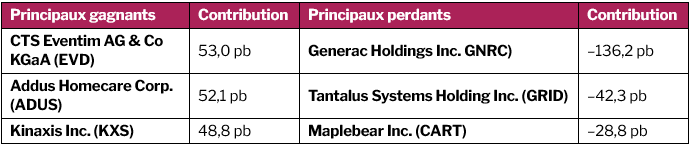
CTS , après une période de faiblesse du cours de son action, a été le principal contributeur ce mois-ci. Kinaxis , qui continue de mettre en œuvre sa prochaine phase de croissance, figure aussi parmi les grands gagnants du mois. Le 20 juillet 2026, l’entreprise a nommé Herb Yeh au poste de chef de la direction financière et chef de la stratégie. Yeh, un banquier d’affaires chevronné, a pour mandat de relever la visibilité internationale de l’entreprise et d’instaurer une politique d’allocation du capital plus active, y compris par des F&A potentielles. La compagnie a aussi fait part de résultats financiers solides pour le deuxième trimestre, et elle a revu à la hausse ses prévisions annuelles pour le chiffre d’affaires total et pour le chiffre d’affaires en matière de SaaS. Le carnet de commandes a augmenté de 18 % d’une année sur l’autre. Par ailleurs, l’entreprise a constaté que la demande augmentait au sein de la chaîne de valeur de la haute technologie — augmentation stimulée par la construction accélérée des centres de données — de même qu’en défense et en aérospatiale.
Generac a subi la perte la plus importante au cours du mois, malgré la publication de résultats solides et le maintien de ses prévisions pour 2026. Le carnet de commandes lié aux centres de données a atteint 1,6 milliard $ (contre 700 millions $ à la fin du T1), grâce à une commande de 700 millions $ passée par un fournisseur de services à très grande échelle, leur premier. La société est par ailleurs en pourparlers avec un deuxième tel fournisseur pour une commande similaire ou plus importante encore. Malgré un bond de 3,39 % du cours de l’action à la suite de la publication des résultats du T2, le titre est demeuré sous pression, s’échangeant en dessous de ses moyennes mobiles sur 20, 50 et 200 jours à la fin du mois. Notre thèse demeure inchangée.
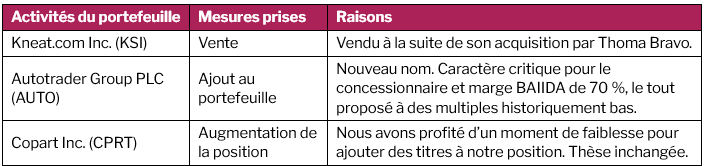
Nous avons créé une position dans Auto Trader, société britannique qui offre une plateforme verticale et qui, selon nous, jouit d’une position quasi monopolistique dans l’esprit des clients (avec une part estimée à plus de 85 %). Elle joue un rôle critique pour les concessionnaires et affiche une marge BAIIDA de 70 %. Cette opportunité nous a semblé particulièrement attrayante, le titre s’échangeant à un ratio C/B historiquement bas de 13x. À nos yeux, l’avantage concurrentiel ne repose pas uniquement sur le trafic lié aux petites annonces, il relève également des données propriétaires concernant l’intention d’achat, de son architecture de tarification et de son intégration aux flux de travail. Le fait que cette position augmente notre exposition internationale nous plaît aussi. Elle s’intègre bien à notre stratégie de diversification visant à réduire la prépondérance des actions canadiennes dans notre portefeuille.
Équipe des actions à petite capitalisation Pender
août 24, 2026
1 Tous les rendements signalés sont ceux des parts de catégorie F du Fonds. D’autres catégories de parts sont offertes. Celles-ci pourraient présenter des frais et des rendements différents. Les données standards sur le rendement du Fonds sont présentées ici : https://penderfund.com/fr/fund/pender-global-small-mid-cap-equity-fund/