In November, the S&P/TSX Composite Index advanced, reaching a new record high. In commodity markets, gold prices rose, and silver also hit an all-time high, making Materials one of the month’s strongest-performing sectors, alongside Consumer Staples.
A major development during the month was Prime Minister Mark Carney’s first federal budget, which outlined new spending aimed at strengthening Canada’s economic competitiveness, reducing reliance on US trade, and meeting defence commitments to NATO.
AI also remained a topical theme. While AI exerts less influence on the Canadian market than in the US, the global boom continues to create a divide between perceived winners and laggards. Shopify, the second-largest TSX constituent, is viewed as a beneficiary, while many software and IT services companies have faced negative sentiment tied to AI-related risks.
These dynamics are creating opportunities. Several sectors that have lagged recent rallies now offer attractive entry points, with compelling valuations and the potential for sentiment to improve as resilient businesses continue to execute. In this environment, we are finding value in high-quality companies with strong fundamentals that are temporarily out of favour due to macroeconomic or sector-specific pressures.

Portfolio weights remain roughly 92.3% Canadian equities, 10.8% US equities.
For November, the Materials sector dominated the Fund’s top contributors, with notable performance from holdings exposed to gold, silver and copper. Historically, we have maintained limited exposure to mining — deliberately. Many mining companies are price takers with limited control over their economics and require ongoing capital investment, which doesn’t always align with our preference for businesses that offer durable competitive advantages, cost discipline and predictable returns on capital.

That said, we apply this discipline with flexibility. We are value investors first, and when the risk/reward becomes compelling, we are prepared to act.
Highlander Silver is a good example. The company offered exposure to a rare, high-grade precious metals asset with significant strategic backing. The company is advancing the San Luis gold-silver project in central Peru, one of the highest-grade undeveloped deposits globally. We are also encouraged by the presence of experienced, value-creating shareholders including the Lundin family.
On the detractor side, Dye & Durham weighed on returns for another month. The company reported preliminary unaudited results for FY25 and Q1 FY26, highlighting ongoing delayed filings, and the launch of cost-cutting and product-streamlining initiatives. It also updated investors on covenant compliance, continued to operate under an MCTO. Management continues to focus on other balance sheet strengthening initiatives, including its expected sale of Credas to help reduce net leverage.
Outlook
Equity markets have appreciated meaningfully through 2025, even as global uncertainties persist. Against this backdrop, we continue to favour resilient, cash-generating businesses while selectively adding to mispriced cyclical opportunities. This balanced approach gives us the flexibility to deploy capital when volatility creates more favourable entry points.
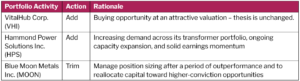
We remained active through the month, adding to high-conviction positions and exiting names where our thesis had weakened. This disciplined rotation supports risk management and positions the Fund to participate meaningfully when market conditions improve.
These are markets that excite us. After a challenging period for small caps, the environment is turning more constructive. Historically, broad small-cap selloffs — often driven by macro forces such as tighter financial conditions, risk-off sentiment or capital crowding into mega caps — have created attractive setups for forward returns. As conditions normalize, liquidity improves and investor attention broadens, these dislocations have often set the stage for compelling multi-year performance.
Today, we see a similar backdrop. Small-cap valuations remain near historic lows relative to large caps — levels that have historically aligned with above-average forward returns for quality-oriented, fundamentals-driven strategies like ours.
David Barr and Amar Pandya
December 17, 2025
1 All Pender performance data points are for Class F of the Fund. Other classes are available. Fees and performance may differ in those other classes. Standard Performance Information for Pender’s Equity Funds may be found here: https://penderfund.com/fund/pender-small-cap-opportunities-fund/.